

By Mark Hughes August 17, 2026
Recurring billing becomes a chargeback problem when customers can sign up easily but cannot understand, manage, or cancel the subscription just as clearly.
That problem affects far more than streaming services. Credit-repair merchants, SaaS companies, ecommerce sellers, membership organizations, continuity programs, professional services, and other businesses may collect recurring payments under arrangements in which charges continue until the customer takes action to stop them.
The legal and payment environment is complicated because there is no single rule that answers every cancellation question.
A merchant may simultaneously need to consider federal consumer-protection law, the Restore Online Shoppers’ Confidence Act (ROSCA), the Federal Trade Commission’s current Negative Option Rule, state automatic-renewal laws, card-network standards, processor requirements, and the merchant’s own contract.
The regulatory history around the widely discussed click to cancel rule makes careful analysis especially important. The FTC adopted broad amendments to its Negative Option Rule that included streamlined cancellation requirements, but the U.S. Court of Appeals for the Eighth Circuit vacated that rule in its entirety.
The FTC later formally restored the earlier version of 16 CFR Part 425, which applies to traditional prenotification negative-option plans, and subsequently opened a new rulemaking proceeding concerning possible amendments.
That means businesses should not treat the vacated FTC click-to-cancel regulation as a currently enforceable nationwide cancellation rule. At the same time, the court decision did not erase ROSCA, state automatic-renewal statutes, the FTC Act, applicable telemarketing rules, or payment-network obligations.
The practical lesson is simple: subscription billing compliance should be designed as a complete system. Disclosure, recurring payment consent, renewal notices, customer service, payment processing, cancellation, refunds, and evidence retention all affect whether recurring revenue remains healthy or turns into a growing stream of complaints and chargebacks.
This guide provides general educational information for merchants and payment teams. It is not individualized legal advice, and businesses should have qualified counsel evaluate the laws and contractual requirements that apply to their specific products, customers, jurisdictions, and payment arrangements.
What Is Negative-Option Billing?
Negative-option billing describes an arrangement in which the customer’s failure to take an affirmative action can result in continued service, shipment, renewal, or billing under previously agreed terms.
Instead of requiring the customer to actively purchase again at every billing interval, the arrangement continues until a defined event occurs, often cancellation. The FTC has historically used the broader concept of negative-option marketing to describe several arrangements in which silence or failure to reject an offer has contractual consequences.
Common structures include:
- Automatic renewal: A subscription renews at the end of a defined term unless the customer cancels.
- Continuity plan: Products or services continue to be provided periodically until termination.
- Recurring subscription: The customer authorizes regular charges, such as monthly SaaS access or a membership fee.
- Free-to-paid trial: A free or reduced-price introductory period converts to paid billing unless canceled.
- Recurring membership: Access continues while recurring dues are collected.
- Prenotification negative-option plan: The seller announces merchandise that will be sent unless the subscriber rejects the selection. The currently codified FTC Negative Option Rule primarily addresses this narrower, older type of arrangement.
These structures overlap, but they are not legally interchangeable.
A SaaS company charging $49 every month is operating recurring billing, but it is not necessarily operating the same type of “prenotification negative option plan” governed by the currently restored text of 16 CFR Part 425.
An ecommerce club offering a 14-day trial that automatically becomes a monthly membership may instead be governed by ROSCA for an Internet transaction, relevant state law, and applicable network or processor requirements.
The core operational issue is recurring payment authorization. Customers should understand that charges will continue, what those charges will be, when they will occur, and how the arrangement can be stopped.
Merchants that offer recurring billing should therefore avoid treating initial payment authorization as a one-time checkout detail. It is the foundation for every subsequent merchant-initiated or recurring charge.
What Does “Click to Cancel” Mean in the Current Legal Context?
“Click to cancel” became shorthand for the FTC’s attempt to require businesses using negative-option programs to provide cancellation mechanisms that were simple and generally comparable to the method used to enroll.
That phrase remains useful when discussing cancellation design, but merchants must distinguish a consumer-experience concept from the current status of federal law.
The FTC’s broad amended rule would have expanded Part 425 to cover negative-option programs across media and imposed requirements addressing disclosures, affirmative consent, misrepresentations, and cancellation. The agency originally established compliance dates for the new requirements and later delayed part of the compliance schedule.
Before full compliance was required, however, the Eighth Circuit ruled that the FTC’s rulemaking process was procedurally deficient. The court granted the petitions for review and vacated the entire amended rule, rather than leaving its cancellation provisions in force.
The FTC subsequently published a final rule restoring Part 425 to the text that existed before the broad amendments became effective. That restoration took effect February 12, 2026. The current eCFR therefore again identifies Part 425 as the Use of Prenotification Negative Option Plans rule.
The FTC has also begun another rulemaking process. Its current Negative Option Rule advance notice of proposed rulemaking asks for public input on possible amendments intended to address recurring payments and cancellation obstacles. An advance notice is part of a rulemaking process; it is not itself a final nationwide click-to-cancel requirement.
What Merchants Should Follow Now
Businesses should not conclude that “the click to cancel rule was vacated, so cancellation compliance no longer matters.” That would be a serious mistake.
For Internet negative-option transactions, ROSCA still requires disclosure of material terms before billing information is obtained, express informed consent before charging, and simple mechanisms for stopping recurring charges.
State automatic-renewal laws may impose additional requirements, including online cancellation, acknowledgments, reminders, or specific disclosures.
The FTC Act may also apply when marketing or cancellation practices are deceptive or unfair. Telephone sales can involve additional obligations under the Telemarketing Sales Rule.
Meanwhile, card networks and processors may establish their own recurring-payment, stored-credential, notification, dispute, and cancellation requirements. Those rules operate independently of consumer statutes.
A good operational standard is therefore not “do only what the vacated federal rule would have required.” It is to design recurring billing cancellation so a reasonable customer can locate the option, understand the consequences, complete the requested cancellation, receive confirmation, and avoid unauthorized future charges.
One-click subscription cancellation may be an excellent design choice and may be legally required in certain jurisdictions or circumstances, but there is no single nationwide interface specification that every U.S. subscription merchant can safely apply without reviewing the laws governing its particular offer.
Federal Rules vs. State Auto-Renewal Laws
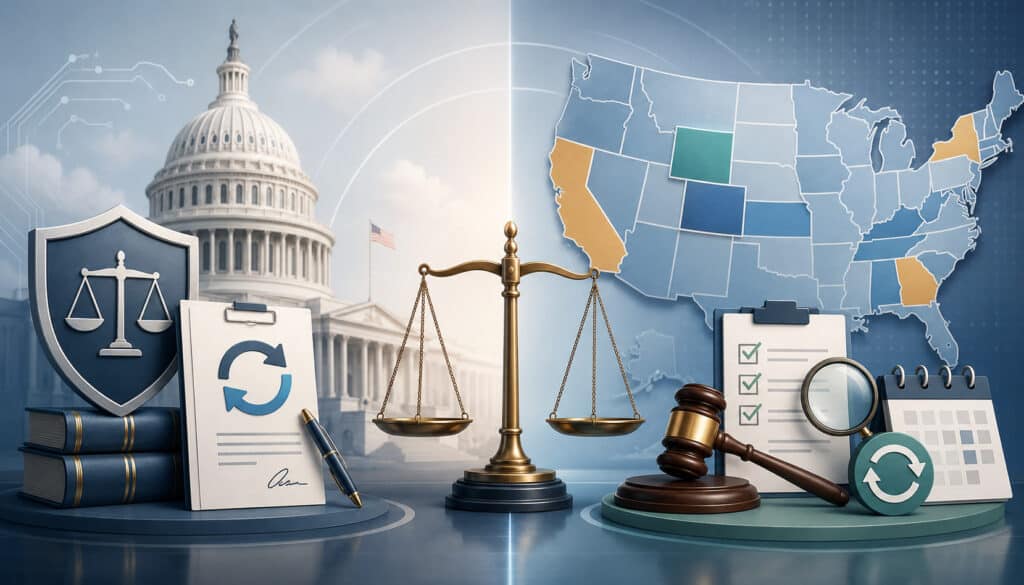
Subscription businesses often make one of two mistakes: they assume federal law answers every automatic renewal cancellation question, or they focus entirely on state law and overlook federal requirements.
A stronger approach separates the layers.
ROSCA applies to certain negative-option transactions effected on the Internet. The FTC Act provides broader authority over unfair or deceptive acts and practices. The Telemarketing Sales Rule may apply to covered telemarketing transactions.
The current FTC Part 425 rule, meanwhile, is limited to its defined prenotification negative-option plans and should not be described as a universal subscription rule.
States may impose different or additional obligations. Depending on the jurisdiction and transaction, these can address the formatting and placement of automatic-renewal terms, affirmative agreement, renewal notifications, free-trial conversion notices, cancellation channels, acknowledgment emails, online cancellation, material changes, or timing.
For example, Vermont law illustrates how specific state requirements can become. For certain covered contracts, the statute addresses affirmative opt-in, advance renewal notice, accessible cancellation mechanisms, and online termination for contracts accepted online. Those requirements come from state law, not from the vacated FTC click-to-cancel regulation.
New York enforcement provides another example of why merchants should review state law separately. The New York Attorney General has pursued automatic-renewal cases involving disclosures, affirmative consent, acknowledgments, renewal notices, and cancellation practices.
| Compliance Area | Federal Requirements | State Requirements | Merchant Action |
| Enrollment disclosure | ROSCA and other federal rules may require disclosure of material terms in covered transactions | May dictate specific renewal disclosures, formatting, or placement | Show material terms before payment and map state-specific requirements |
| Consent | ROSCA requires express informed consent for covered online negative-option charges | Some states impose affirmative-consent requirements | Preserve a clear consent event and accepted terms |
| Renewal notice | No single universal federal reminder period applies to all subscriptions | Some states require notices for defined renewal structures | Determine which customers and plans require notices |
| Cancellation method | ROSCA requires simple mechanisms to stop recurring charges | States may require online cancellation or specified channels | Offer accessible cancellation suited to enrollment method and jurisdiction |
| Confirmation | Federal requirements vary by program | Some states require acknowledgments or other communications | Send and retain cancellation confirmation |
| Recordkeeping | Depends on applicable rule and enforcement context | Requirements vary | Keep defensible consent, notice, cancellation, and transaction records |
Businesses selling nationwide should avoid building compliance around the least demanding jurisdiction. A centralized subscription platform can support a common baseline while triggering additional notices or cancellation functions for plans subject to stricter state rules.
ROSCA and Online Negative-Option Billing

The Restore Online Shoppers’ Confidence Act, commonly called ROSCA, remains one of the most important federal statutes for Internet subscription billing.
The statute makes it unlawful to charge or attempt to charge a consumer for goods or services sold through an Internet transaction using a negative-option feature unless the seller meets three core conditions.
Under 15 U.S.C. § 8403, the seller must:
- Clearly and conspicuously disclose all material transaction terms before obtaining the consumer’s billing information.
- Obtain the consumer’s express informed consent before charging the consumer’s financial account.
- Provide simple mechanisms for the consumer to stop recurring charges.
These requirements are highly relevant to subscriptions, continuity programs, memberships, and free-to-paid offers sold online.
ROSCA does not specify a universal button color, a particular cancellation-page layout, or one mandatory number of clicks. Instead, merchants should assess whether the actual mechanism allows customers to stop recurring charges without unreasonable barriers.
That distinction matters. A cancellation link can technically exist while the surrounding workflow still creates problems.
For example, suppose a subscription customer selects “Cancel membership,” but the merchant forces the customer through six retention pages, repeatedly labels continuation buttons more prominently than cancellation controls, then requires a phone call during restricted hours.
The mere existence of an initial cancel link does not resolve the consumer-protection concerns created by the full process.
The FTC’s negative-option enforcement policy statement has emphasized disclosures, informed consent, and honoring cancellation requests without erecting unreasonable barriers.
Internet Billing Should Be Evaluated as a Complete Transaction
A compliant-looking checkbox cannot repair an enrollment flow that obscures the price.
Likewise, excellent disclosures cannot compensate for billing after the merchant has accepted a valid cancellation.
Payment teams should review the full subscription lifecycle:
- advertising,
- offer page,
- checkout,
- consent,
- confirmation,
- trial conversion,
- renewals,
- payment credentials,
- customer account access,
- cancellation,
- refunds,
- dispute documentation.
Credit-repair companies that use recurring payment arrangements should pay particular attention because the payment model can become central to both customer expectations and processor risk.
Resources discussing merchant services and recurring billing for credit-repair businesses can help operational teams understand how recurring payments fit into the broader processing environment.
Consent Before Recurring Billing
Valid recurring payment consent should establish more than the customer’s willingness to make the first purchase. It should document the recurring nature of the transaction.
The enrollment process should present material terms before the payment commitment and should create a reliable record showing what the customer accepted.
Depending on the product and applicable law, useful consent records may include:
- subscription price;
- billing frequency;
- renewal structure;
- trial duration;
- date paid billing begins;
- post-trial price;
- minimum term, if any;
- cancellation method;
- material cancellation restrictions;
- refund terms;
- automatic renewal terms;
- customer identifier;
- timestamp;
- IP or device evidence where lawfully and appropriately collected;
- version of the terms accepted;
- affirmative action used to demonstrate consent.
A common mistake is keeping only a database field that says subscription_active = true. That proves the system considered the account active; it does not necessarily prove how the customer agreed to recurring charges.
A stronger record might show that the customer was presented with “$29.95 per month until canceled,” selected an unchecked recurring-payment consent control, completed the order, and received an acknowledgment containing the subscription terms.
Avoid relying on preselected controls, confusing double negatives, or design techniques that make refusal difficult. Even where a specific interface is not expressly prohibited by one statute, misleading consent practices can create broader consumer-protection and dispute risk.
What Good Subscription Disclosures Look Like
Effective subscription disclosures are visible where the payment decision happens.
The customer should not have to search a long terms-of-service document to learn the recurring price, frequency, conversion date, or cancellation requirements. Material subscription terms should appear close enough to the enrollment action that a reasonable customer understands what will happen after clicking the payment or enrollment control.
A practical disclosure might communicate:
- “$19.99 today, then $49.99 every 30 days until canceled.”
- “Your 14-day trial converts to a monthly membership on September 18 unless you cancel before conversion.”
- “Annual membership renews automatically at $199 unless canceled before the next renewal.”
The correct wording depends on the offer and applicable legal requirements, but specificity reduces ambiguity.
Merchants should also keep screenshots or rendered versions of the checkout experience associated with each material terms version. When customer disputes recurring payments months later, a generic copy of today’s website may not establish what the customer saw.
Dark Patterns, Signup Friction, and One-Click Subscription Cancellation
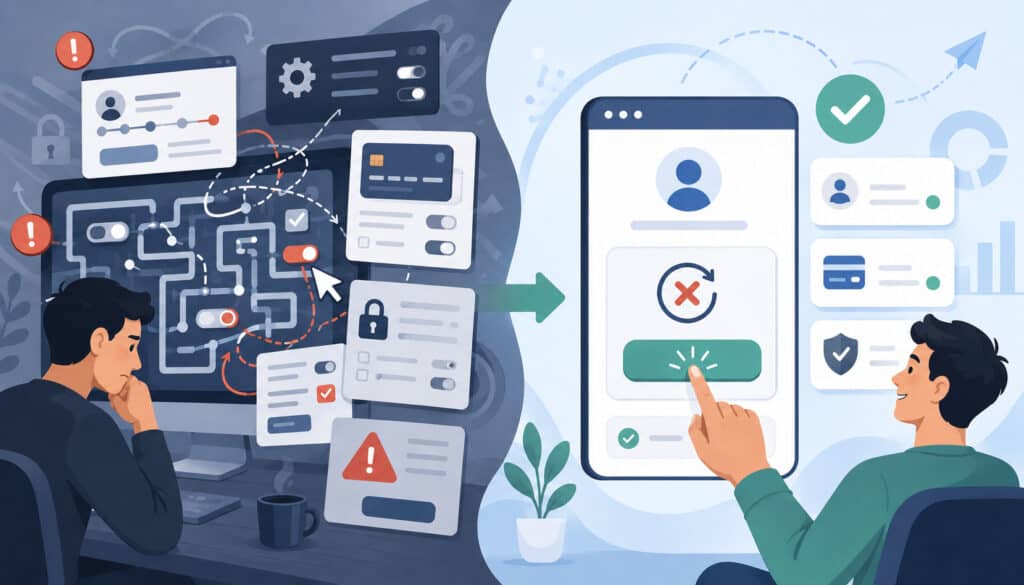
Cancellation design should not become a retention strategy built around customer exhaustion.
Problematic practices can include hiding the cancellation control deep inside account menus, using misleading labels, requiring unnecessary phone contact, forcing repeated retention screens, preventing cancellation unless a survey is completed, or continuing to bill after the merchant has confirmed termination.
A reasonable retention offer is different. A merchant can explain what the customer will lose, offer a lower-priced plan, suggest pausing service, or provide a voluntary incentive to stay.
The critical distinction is whether the customer remains free to complete the cancellation.
Signup vs. Cancellation Friction
When enrollment takes 30 seconds but cancellation requires multiple support contacts over several days, the imbalance increases legal, reputational, and dispute risk.
The vacatur of the FTC’s broad rule does not make intentionally obstructive cancellation a safe business practice. ROSCA still requires simple mechanisms for covered Internet negative-option transactions, and state laws may impose their own requirements.
Operationally, merchants should ask:
- Can the customer find the cancellation control without searching help articles?
- Does the system clearly distinguish “pause,” “downgrade,” and “cancel”?
- Are retention offers optional?
- Does authentication protect the account without creating excessive barriers?
- Can mobile customers complete cancellation successfully?
- Does cancellation propagate to the billing platform?
- Is confirmation immediate?
- Can support agents see that the cancellation occurred?
One-click subscription cancellation does not have to mean an accidental single-tap termination with no explanation. A merchant can present the plan, effective date, loss of benefits, and a clear confirmation action without turning the process into an obstacle course.
When Online Cancellation Is Appropriate
Online cancellation is often operationally sensible when enrollment occurred online because it gives customers continuous access, reduces call-center volume, produces reliable timestamps, and can update billing systems automatically.
In some jurisdictions, online cancellation may also be required for covered subscriptions accepted online. Vermont’s statute, for example, requires online termination for certain consumer contracts accepted online.
Other states use different frameworks, which is why businesses should not assume one interface satisfies every automatic renewal law.
Recommended Recurring Billing Cancellation Workflow
A reliable recurring billing cancellation workflow should connect the customer’s request to the actual payment system.
A cancellation page that changes only the website’s display status is not enough if the gateway continues sending recurring charges.
A practical workflow is:
- Customer opens account or subscription settings: The customer should be able to identify the active plan without contacting support merely to determine what is being billed.
- Current plan and renewal date are displayed: Show the amount, billing frequency, next scheduled charge, and any relevant term information.
- The cancellation option is easy to identify: Do not hide cancellation behind unrelated menus or misleading controls.
- Material consequences are explained: Tell the customer whether access ends immediately, at the end of the paid term, or according to another contractually permitted outcome.
- Customer confirms cancellation: The confirmation action should clearly communicate that the subscription will stop renewing.
- The billing system prevents future eligible charges: Update the subscription engine, payment gateway, vault reference, or processor instructions as appropriate.
- Confirmation is displayed and sent: Provide a durable confirmation such as email or an account message.
- Cancellation timestamp is stored: Record the request time, effective date, channel, account, and resulting status.
- Processor and subscription records are synchronized: Prevent stale status data from causing a later charge.
- Customer-service history is retained: Agents should be able to see what happened without asking the customer to repeat the entire process.
Cancellation Confirmation and Effective Dates
A cancellation confirmation should answer the questions customers are most likely to ask later.
Useful fields include:
- customer or account identifier;
- subscription name;
- cancellation request timestamp;
- cancellation channel;
- cancellation effective date;
- final paid-through date;
- whether another charge is pending;
- final billing status;
- refund status, where applicable;
- confirmation or reference number.
Confirmation protects both parties.
If the customer later says, “I canceled before renewal,” the merchant can compare the cancellation timestamp with the billing event. If the merchant discovers that its own system charged after the effective cancellation date, the same evidence helps support a prompt correction.
Immediate vs. End-of-Term Cancellation
Cancellation does not always mean access must terminate immediately.
A monthly SaaS customer who has already paid through October 31 might cancel renewal on October 10 and retain service through October 31. Another product may terminate service immediately and provide a prorated refund when required by contract or law.
The merchant should clearly disclose what “cancel” means for that plan.
Avoid ambiguous messages such as “Your cancellation request has been submitted” when the user reasonably expects billing to have stopped. If additional processing is genuinely necessary, communicate the current status and effective date.
Cancellation confirmation should never promise that billing has stopped if a renewal transaction is already irreversibly in process.
Free Trials, Renewal Reminders, and Material Changes
Free trials can generate high conversion rates, but they also create recurring transaction disputes when customers do not understand when free access becomes paid access.
A trial offer should prominently communicate:
- how long the trial lasts;
- whether payment credentials are collected;
- the exact or determinable conversion date;
- the post-trial price;
- billing frequency after conversion;
- automatic renewal terms;
- how to cancel before conversion.
A label such as “Start Free Trial” should not be the only meaningful disclosure if the customer is actually authorizing future charges.
Renewal Reminders
There is no single universal reminder period that applies to every subscription in every U.S. jurisdiction.
State automatic-renewal laws can impose reminder requirements based on contract duration, renewal length, price changes, trial structure, or other factors. Payment-network rules may also require notifications for certain recurring arrangements.
For example, Vermont’s automatic-renewal statute illustrates how a state can specify a notice window for covered contracts. New York enforcement has likewise focused on businesses that failed to provide renewal-related notices required under that state’s framework.
Businesses should therefore configure renewal notifications using legal rules tied to the applicable plan and customer rather than choosing one arbitrary national schedule.
Even where a notice is not legally required, a well-timed reminder can reduce surprise renewals and customer disputes.
Useful renewal messages may include:
- merchant name;
- subscription name;
- renewal date;
- renewal amount;
- billing frequency;
- cancellation instructions;
- account-management link.
Material Price or Plan Changes
Changes to price, renewal frequency, service scope, or other material terms deserve separate review.
Depending on the governing law and contract, a material change may require advance notice, revised disclosure, new consent, or another action.
Do not assume that a customer’s original authorization to pay $19.95 monthly automatically authorizes materially different future billing forever.
From a dispute standpoint, price changes should also be traceable. Keep the notice sent, delivery record where available, effective date, and version of revised terms.
Card-Network Recurring Payment Rules
Card-network standards are not the same as consumer law.
Visa or Mastercard rules can govern how recurring card payments are authorized, identified, stored, submitted, canceled, and disputed. These rules typically operate through the merchant’s acquirer or processor, and they may impose requirements that do not appear in federal or state consumer statutes.
Similarly, complying with a network rule does not establish compliance with ROSCA or an automatic-renewal law.
Recurring Billing and Stored Credentials
A typical recurring card relationship begins with a customer-initiated transaction or credential setup in which the customer provides authorization.
Later payments may be submitted under a stored-credential or recurring framework without the customer actively entering card details each time. Those later transactions need to be correctly classified and supported by the appropriate authorization relationship.
Visa and Mastercard use detailed stored-credential frameworks, and merchants should not assume their terminology or implementation rules are identical.
Visa’s Subscription Manager materials illustrate how issuers and the Visa network can support cardholder management of stored-credential subscription payments, including stop instructions. Visa’s documentation also explains that transactions matching certain stop instructions may be declined and should not simply be resubmitted by the merchant.
Mastercard has separately published standards for subscription, recurring-payment, and negative-option merchants, including notification and account-management concepts that vary depending on the merchant and program circumstances.
Merchants should obtain the current rules applicable to their merchant category and processing setup through their acquirer or processor.
Processor and Acquirer Requirements
Processor requirements can go beyond network minimums.
A recurring billing merchant account agreement may require the business to maintain specific refund policies, retain authorization records, use approved descriptors, notify the processor about substantial business-model changes, or comply with risk-management procedures.
Credit-repair businesses and other merchants that processors consider higher risk may face closer underwriting and monitoring.
Your processor should be able to explain:
- how recurring transactions are flagged;
- how stored credentials are registered;
- how cancellation affects future billing;
- how refunds reference original transactions;
- what evidence can be exported for disputes;
- what recurring billing activity triggers risk review;
- how descriptor changes are handled.
Cancellation Disputes and Recurring Billing Chargebacks
Recurring payment disputes often begin with a customer-experience failure rather than stolen-card fraud.
The customer may recognize the merchant but believe the charge should not have occurred.
Typical cancellation disputes include:
- “I canceled before the renewal.”
- “I didn’t know this would renew.”
- “I thought the trial was free.”
- “I canceled but was charged again.”
- “I don’t recognize this descriptor.”
- “I never agreed to monthly billing.”
- “I contacted support but nobody canceled it.”
- “I thought I was buying once, not subscribing.”
When the merchant lacks documented recurring payment authorization or cancellation history, even an otherwise legitimate subscription can become difficult to defend.
Why Cancellation Problems Become Payment Problems
The operational chain often looks like this:
Poor Cancellation Experience → Customer Complaint → Refund Request → Dispute/Chargeback → Processor Risk
A customer who cannot find the cancellation option may contact support. If support is slow, the customer may request a refund.
If that request is ignored or denied without reviewing the cancellation evidence, the cardholder may dispute the transaction with the issuing bank.
Recurring billing chargebacks can increase direct processing costs and consume support time. Persistent dispute problems may also contribute to additional processor scrutiny, reserves, merchant account review, remediation requirements, or potential account-retention concerns, depending on the merchant’s circumstances.
There is no single universal chargeback threshold that every merchant should use as a safe harbor. Network monitoring programs, processor contracts, merchant category, transaction volume, fraud levels, and other factors can affect risk treatment.
Businesses should focus on preventing avoidable disputes rather than attempting to operate just below a perceived threshold.
Common Causes of Recurring Transaction Disputes
- Unexpected renewal: The customer understood the initial purchase but overlooked automatic renewal.
- Unexpected trial conversion: The customer knew about the trial but did not understand the post-trial price or conversion date.
- Post-cancellation billing: The customer completed cancellation, but a stale system continued billing.
- Unrecognized descriptor: The name shown on the statement differs from the brand the customer remembers.
- Missing consent evidence: The merchant cannot reproduce the recurring terms accepted at signup.
- Failed cancellation confirmation: The customer believes cancellation occurred, while the merchant has no reliable record.
A merchant responding to formal disputes can learn more about assembling supporting material in this guide to chargeback rebuttal letters and dispute evidence.
Preventing Customer Disputes Over Recurring Payments
The most effective subscription dispute prevention program starts before the first transaction.
Clear enrollment establishes expectations. Reliable cancellation prevents unauthorized future billing. Good records allow support teams to resolve disagreements before they turn into formal disputes.
Key controls include:
- visible subscription terms at checkout;
- affirmative recurring-payment consent;
- recognizable transaction descriptors;
- renewal reminders when required or appropriate;
- accessible customer accounts;
- straightforward automatic renewal cancellation;
- immediate cancellation confirmation;
- responsive support;
- timely investigation of refund requests;
- correct recurring transaction indicators;
- accurate stored-credential handling;
- durable consent and cancellation records.
Refund vs. Chargeback
A legitimate refund can be less disruptive than forcing a customer to initiate a chargeback.
That does not mean every complaint should automatically receive a refund. Merchants should review the facts, contract terms, applicable law, cancellation evidence, fulfillment history, and payment status.
Suppose a customer canceled two days before renewal, the cancellation log confirms the event, and an integration failure caused another charge. Promptly correcting that error is usually better operationally than disputing the customer’s account of events.
A different case may involve a customer who used the service throughout a paid term and disputes a properly authorized renewal without evidence of prior cancellation. The merchant may have a legitimate basis to respond to the dispute with documentation.
The point is to separate genuine billing errors from unsupported claims.
Transaction Descriptors
A recognizable billing descriptor can prevent avoidable “I don’t recognize this charge” disputes.
The descriptor should connect reasonably to the name customers know. If the legal entity and consumer-facing brand differ substantially, consider whether the descriptor or associated customer-service information can reduce confusion within network and processor rules.
Test descriptors by viewing actual settled transactions, not merely configuration fields inside the gateway.
Billing After Cancellation
Few recurring billing problems are more damaging than charging customers after an effective cancellation.
The problem is often technical rather than intentional.
Common causes include:
- billing jobs created before the cancellation event;
- delayed asynchronous processing;
- CRM-to-billing sync failures;
- gateway subscription records that remain active;
- multiple subscriptions under one customer account;
- duplicate customer profiles;
- stale cached account status;
- webhook delivery failures;
- manual cancellations that never reach the processor;
- retries performed after cancellation;
- timezone differences around renewal cutoffs.
A merchant should define exactly when future billing becomes prohibited under the subscription’s governing terms and then make the technical system enforce that state.
Cancellation and Payment-System Integration
A reliable architecture connects:
Customer Account → Subscription Platform → Gateway/Vault → Processor → CRM/Support
When the customer cancels, each system that can cause or authorize future billing should eventually reflect the appropriate status.
For example, the account interface might mark the subscription “scheduled to cancel.” The subscription platform should prevent creation of a renewal invoice after the effective date.
The gateway should not keep an independent recurring schedule running unless that schedule is intentionally part of the architecture. Support agents should see the same cancellation event so they do not incorrectly tell the customer the subscription remains active.
Reconciliation jobs can identify mismatches such as:
- account canceled but gateway active;
- billing active but subscription expired;
- refund completed but CRM says pending;
- cancellation confirmed but renewal invoice generated.
Idempotent Cancellation
Technical teams should make cancellation operations idempotent where practical.
In simple terms, repeated requests to cancel the same subscription should reach the same safe result rather than producing conflicting states.
If a customer presses the cancellation button twice because the page loads slowly, the second request should not accidentally restore the subscription. Likewise, an agent retrying a failed cancellation call should not create multiple contradictory events.
A good cancellation endpoint might safely interpret:
- cancel active subscription → schedule or complete cancellation;
- cancel already canceled subscription → return existing cancellation state;
- cancel subscription with payment pending → flag the pending payment for defined handling;
- cancel subscription after renewal processed → apply the merchant’s post-renewal workflow.
The exact implementation varies, but the goal is consistent.
Webhooks and Cancellation Events
Subscription systems frequently rely on asynchronous events to keep platforms synchronized.
Useful conceptual events include:
- cancellation requested;
- cancellation scheduled;
- cancellation effective;
- renewal prevented;
- invoice voided;
- payment already pending;
- refund initiated;
- refund completed.
These are illustrative concepts, not universal webhook names.
Webhooks should be authenticated, logged, retried after transient failures, and reconciled against system state. An event that fails silently can become a post-cancellation charge weeks later.
Cancellation Status Models and Customer-Service Controls
A subscription’s status should communicate more than “active” or “inactive.”
Operational complexity often requires intermediate states.
Illustrative internal statuses might include:
- active
- cancellation requested
- scheduled to cancel
- canceled
- payment pending
- refund pending
These labels are not mandated legal categories. They are examples of how a merchant can model different stages so billing and support teams know what action is permitted.
For example, “scheduled to cancel” could mean the customer has successfully stopped future renewal but retains paid access through the end of the term.
“Cancellation requested,” by contrast, should not become a permanent holding status that allows recurring charges to continue simply because a back-office team has not processed the request.
Customer-Service Cancellation Controls
Support agents need tools that match the promises made on the website.
Train agents to:
- locate the subscription quickly;
- view the current renewal date;
- identify pending charges;
- see prior cancellation attempts;
- process authorized cancellations;
- explain the effective date;
- resend confirmation;
- escalate post-cancellation billing errors;
- initiate refunds when authorized;
- avoid unnecessary retention barriers.
A customer should not receive three different answers from three different departments because each system holds a different subscription status.
Retention Offers
Retention efforts can coexist with consumer choice.
A merchant might offer:
- a discounted plan;
- a temporary pause;
- a lower service tier;
- account credits;
- fewer deliveries;
- another billing frequency.
The customer should remain able to decline the offer and proceed with cancellation.
Repeated screens that obscure the cancellation button, forced conversations, misleading “continue” labels, or mandatory surveys can turn retention into friction.
A useful design test is whether the customer still understands exactly which action cancels and whether saying “no thanks” allows them to finish.
Phone, Email, and Online Cancellation
Whether a merchant may require a particular cancellation channel depends on the applicable law, enrollment method, contract, and business context.
Some state statutes specifically address online cancellation for agreements entered into online. ROSCA requires simple mechanisms for covered Internet recurring charges but does not establish one universal cancellation user interface for every transaction.
Even where phone cancellation remains legally available, businesses should consider accessibility and operating hours.
If an online customer can enroll at 11:30 p.m. on Sunday but cancellation requires calling between 9 a.m. and 4 p.m. on weekdays, that friction can predictably create support complaints.
Evidence for a Recurring Billing Dispute
A recurring transaction dispute is easier to investigate when the merchant has a chronological evidence package.
Useful records may include:
- enrollment timestamp;
- offer page;
- checkout disclosure;
- affirmative consent record;
- terms version;
- initial transaction details;
- subscription confirmation;
- trial details;
- renewal reminders;
- notices of material changes;
- customer communications;
- cancellation attempts;
- cancellation timestamp;
- cancellation confirmation;
- transaction records;
- service-use information where relevant;
- refund history.
Do not retain unnecessary sensitive payment data simply because it might someday be useful in a dispute.
Cardholder data should be handled according to applicable security and PCI DSS requirements, and merchants should rely on tokenization or processor-hosted storage where appropriate.
Build a Chronological Evidence Record
Dispute evidence should tell a coherent story.
For example:
- Customer enrolled on March 4.
- Checkout showed $10 introductory price followed by $39 monthly billing.
- Customer affirmatively agreed.
- Confirmation was sent.
- Renewal notice was sent where applicable.
- Renewal processed on April 4.
- Customer requested cancellation on April 10.
- Cancellation became effective before the May renewal.
- No additional charges were submitted.
That timeline is much stronger than a pile of unrelated screenshots.
If the timeline instead reveals that a May charge occurred after an April cancellation, the evidence has served another purpose: identifying a billing error that should be corrected.
Metrics Merchants Should Monitor
Subscription businesses should measure cancellation quality just as they measure conversion and churn.
Useful metrics include:
- cancellation completion rate;
- cancellation abandonment caused by technical errors;
- cancellation-related support contacts;
- average time to process cancellation;
- post-cancellation billing errors;
- cancellation confirmation failures;
- renewal refund rate;
- recurring-payment dispute rate;
- trial-conversion complaints;
- unrecognized-descriptor complaints;
- billing-system synchronization failures.
Avoid importing generic benchmarks without understanding how they were calculated.
A SaaS merchant with annual enterprise contracts, an ecommerce continuity program, and a credit-repair company with monthly service billing have different customer behavior and dispute profiles.
The more useful comparison is often the merchant’s own trend.
If cancellation-related support tickets rise after a redesign, investigate the interface. If trial-conversion refunds increase after changing offer copy, review disclosure placement.
If post-cancellation charges cluster around the first day of the month, inspect billing-queue timing.
Cancellation Audit
At least periodically, run a complete test using a real production-like workflow:
- Sign up as a test customer.
- Review every subscription disclosure.
- Verify affirmative consent is stored.
- Confirm the enrollment acknowledgment is received.
- Locate the cancellation method without internal documentation.
- Count unnecessary steps.
- Test desktop and mobile experiences.
- Cancel close to a scheduled renewal in a controlled environment.
- Verify future billing stops according to the cancellation terms.
- Confirm the cancellation email or receipt.
- Review billing, CRM, gateway, and support logs.
- Test the refund workflow.
- Assemble the evidence that would be available in a dispute.
Include legal, product, engineering, support, and payment personnel when possible. Cancellation is a cross-functional process.
Common Negative-Option Billing Mistakes
Many recurring billing failures are predictable.
- Buried renewal terms: Customers learn that the purchase renews only after reviewing lengthy terms or receiving the first unexpected charge.
- Preselected consent: The system assumes agreement rather than documenting meaningful affirmative action.
- Unclear trial conversion: “Free trial” dominates the offer while the conversion date and future price receive little attention.
- Missing required renewal reminders: The merchant assumes no reminder is necessary because the customer originally agreed to recurring billing.
- Cancellation is harder than enrollment: Customers can sign up online but face unnecessary barriers when leaving.
- Improper phone-only cancellation: A business uses mandatory calls without reviewing whether applicable law permits that process.
- Post-cancellation charges: Technical systems continue billing after an effective cancellation.
- No confirmation: Neither side can later prove when cancellation occurred.
- Unclear statement descriptor: Customers dispute charges they do not recognize.
- Weak consent records: The merchant knows the customer subscribed but cannot reproduce the enrollment terms.
- Ignoring state requirements: A nationwide merchant uses one policy without evaluating customer jurisdiction.
- Relying on outdated FTC summaries: Internal compliance documents still describe the vacated broad FTC rule as currently effective.
- Treating network rules as consumer law: Correct recurring-transaction indicators do not replace statutory disclosure or cancellation requirements.
Cancellation Compliance Checklist
Use this checklist as an operational starting point, not as a substitute for legal review.
| Area | What to Verify |
| Material terms disclosed | Price, frequency, renewal, trial conversion, minimum commitments, and material restrictions appear before enrollment |
| Affirmative consent | The customer takes a documented action showing agreement to recurring billing |
| Billing frequency | Monthly, annual, or other schedule is accurately communicated |
| Trial conversion | Trial duration, conversion date, and post-trial amount are shown |
| Renewal notices | Required notices are triggered by jurisdiction and plan type |
| Cancellation method | Customer has an accessible way to stop recurring billing |
| Online cancellation | Online termination is available where required or operationally appropriate |
| Confirmation | Cancellation result and effective date are communicated |
| Billing-system update | Future eligible charges are actually stopped |
| Refund workflow | Billing errors can be reviewed and corrected quickly |
| Evidence retention | Enrollment, notices, cancellations, and transactions can be reconstructed |
| State-law review | Automatic renewal laws are mapped by customer jurisdiction |
| Network-rule review | Current Visa, Mastercard, acquirer, and processor requirements are reviewed |
Questions Merchants Should Ask Their Billing or Payment Provider
A recurring billing merchant account should support more than scheduled transactions.
Ask potential processors, gateways, or subscription platforms:
- Can we store evidence of affirmative recurring payment consent?
- Can we retain the exact terms version associated with each customer?
- Can customers cancel subscriptions online?
- Can future recurring charges be stopped immediately when appropriate?
- Are cancellation events logged with timestamps?
- Can renewal reminders be automated based on different rules?
- Can refund activity be linked to the original transaction?
- Are stored credentials and recurring indicators handled correctly?
- Can we export cancellation and dispute evidence?
- How are failed cancellation webhooks retried?
- Can stored payment credentials be disabled or removed when appropriate?
- How does the platform handle a renewal already queued when cancellation arrives?
- Can support agents see pending billing activity?
- Which chargeback evidence can be exported?
- How are processor or network stop instructions surfaced to merchants?
- Does the system reconcile subscription status against gateway billing status?
The right answers depend on the merchant’s architecture.
A platform that handles SaaS subscription state internally may need different gateway functionality from a merchant that relies entirely on a processor’s recurring billing engine.
Frequently Asked Questions
What is negative-option billing?
Negative-option billing is an arrangement in which a customer’s silence or failure to cancel can result in continued service, renewal, shipment, or billing under previously authorized terms.
Examples include automatic renewals, recurring memberships, continuity programs, and free-to-paid trials. Different forms can be governed by different statutes and rules, so the term should not be treated as one legal category with identical requirements.
What is the click-to-cancel rule?
The term commonly refers to the FTC’s broad amendments to its Negative Option Rule, which included requirements intended to make cancellation simple and comparable to enrollment.
That amended federal rule was vacated by the Eighth Circuit. The phrase is still widely used as a description of streamlined subscription cancellation, but merchants should not describe the vacated rule as currently enforceable nationwide.
Is the FTC click-to-cancel requirement currently in effect?
The broad FTC rule commonly associated with “click to cancel” is not currently in effect. The Eighth Circuit vacated the amended rule.
The FTC later restored Part 425 to its earlier prenotification-plan text and has begun a new rulemaking process concerning possible amendments. Existing laws such as ROSCA and state automatic-renewal requirements remain important.
What does ROSCA require for online subscriptions?
For covered Internet negative-option transactions, ROSCA requires sellers to disclose material terms clearly and conspicuously before obtaining billing information, obtain express informed consent before charging the customer’s financial account, and provide simple mechanisms for stopping recurring charges.
Businesses should analyze their specific offer and transaction rather than assuming ROSCA is satisfied merely because a cancellation link exists.
Do automatic-renewal laws vary by state?
Yes. State automatic renewal laws can differ significantly in scope, exemptions, disclosure requirements, consent rules, renewal notices, acknowledgments, cancellation methods, and timing.
A business serving customers nationally may therefore need different compliance logic for different subscription structures or jurisdictions. Federal law does not automatically preempt stricter state requirements.
What counts as valid consent for recurring billing?
The answer depends on applicable law, but strong recurring payment consent usually involves a clear disclosure of material recurring terms followed by an affirmative action demonstrating agreement.
Merchants should preserve the accepted terms, price, frequency, trial conditions, timestamp, and consent event. Merely possessing the customer’s card information is not the same as documenting authorization for recurring charges.
Must online subscriptions be cancellable online?
Not every subscription in the United States is governed by one universal federal online-cancellation requirement. However, some state laws require online cancellation for covered agreements entered into online.
ROSCA also requires simple mechanisms to stop recurring charges in covered Internet transactions. Merchants should evaluate the applicable jurisdiction and avoid designing cancellation around outdated assumptions about the vacated FTC rule.
Can a business require customers to call to cancel?
Sometimes a phone channel may be permitted, but businesses should not assume phone-only cancellation is compliant for every subscription. State law, enrollment method, ROSCA, contract terms, and other requirements may affect the answer.
Even where lawful, unnecessarily restricted call hours or repeated retention barriers can increase complaints and recurring billing chargebacks.
Are renewal reminders required?
They can be. Reminder requirements depend on jurisdiction, contract duration, renewal structure, trial type, and sometimes card-network standards. There is no universal notice period that applies to every U.S. subscription.
Merchants should map reminder triggers to the specific plans and customers subject to each rule instead of applying an unsupported national deadline.
What happens if a merchant charges after cancellation?
First determine whether the cancellation had already become effective under the applicable terms and law. If the charge should not have occurred, investigate quickly, stop further billing, correct affected systems, and evaluate whether a refund is appropriate.
Repeated post-cancellation charges can generate customer disputes, chargebacks, regulatory complaints, and processor scrutiny.
Why do recurring payments lead to chargebacks?
Recurring payments often produce disputes because the customer does not actively approve every transaction. Unexpected renewals, forgotten subscriptions, unclear trial conversions, unrecognized descriptors, and failed cancellations can therefore become issuing-bank disputes.
Better disclosure, reminders where appropriate, recognizable descriptors, accessible cancellation, and responsive support can reduce avoidable claims.
What evidence helps defend a recurring billing dispute?
Useful evidence can include the enrollment page, recurring billing disclosure, affirmative consent event, terms version, transaction records, confirmation messages, renewal notices, customer communications, service history where relevant, cancellation records, and refund activity.
The evidence should establish a chronological account of what the customer agreed to and what occurred afterward.
Can retention offers be shown during cancellation?
Generally, businesses can offer alternatives such as discounts, pauses, or plan changes, subject to applicable law. The offer should remain optional and should not conceal, disable, or unnecessarily delay cancellation.
A customer who declines a retention offer should be able to continue through the cancellation workflow without repeatedly fighting the same prompt.
How should merchants confirm cancellation?
Show confirmation immediately and provide a durable record such as an email or account message. Include the subscription, cancellation date, effective date, remaining access if applicable, future billing status, and a reference identifier. Internally, preserve the timestamp, channel, account identifier, and resulting billing-system status.
How can subscription businesses reduce cancellation disputes?
Start by making the recurring terms unmistakable at enrollment and documenting consent. Give customers reliable access to account and billing information, send required or useful reminders, make cancellation easy to locate, synchronize cancellation with the payment system, provide prompt confirmation, investigate billing errors quickly, and retain evidence that can reconstruct the entire subscription lifecycle.
Conclusion
Negative-option billing is not inherently a problem. Customers often value automatic renewals, memberships, subscription services, and recurring payment convenience.
Problems begin when the customer understands only the first transaction while the merchant relies on silence for everything that follows.
The current legal landscape also requires precision. The FTC’s broad click-to-cancel amendments were vacated by the Eighth Circuit, and the agency subsequently restored the earlier prenotification Negative Option Rule while beginning another rulemaking process. Merchants should therefore avoid presenting the vacated regulation as current nationwide law.
But that does not eliminate subscription cancellation obligations.
ROSCA continues to govern covered Internet negative-option transactions. The FTC Act and Telemarketing Sales Rule may apply in appropriate circumstances. States impose their own automatic-renewal requirements.
Card networks maintain recurring-payment and stored-credential standards. Processors and acquirers can impose additional contractual controls.
The strongest subscription billing compliance program brings those requirements together operationally.
Before enrollment, disclose the material recurring terms and document affirmative consent. During the relationship, communicate renewals or changes when required. At cancellation, give the customer an accessible way to stop future billing, explain when cancellation becomes effective, update every relevant payment system, and provide confirmation.
Then preserve the evidence.
That approach does more than support compliance. It reduces refunds caused by confusion, prevents avoidable customer disputes recurring payments can generate, strengthens chargeback documentation, and helps protect the stability of a recurring billing merchant account.
For subscription businesses, cancellation should not be treated as the last page of the customer journey. It is a payment-control function. When cancellation works correctly, unwanted billing stops before the customer’s complaint becomes a chargeback.